Women’s Human Rights, Gender Equality and AI STATEMENT &…
Women’s Human Rights, Gender Equality and AI
STATEMENT & CALL TO ACTION[1]
July 6, 2026
The Global Alliance on Media and Gender, the UNESCO UniTWIN Network on Gender, Media and ICT and the World Association for Christian Communication ((WACC) urge the UN Global Dialogue on AI Governance and the AI for Good Summit to commit to an AI for women and girls.
Debates on AI and women’s human rights are not new. The original discussions and the present-day ones still revolve around power, inequality and discrimination. In the 1990’s, sociologist Judy Wajcman warned that technologies are not neutral spaces, but spaces mediated by power, which perpetuate inequality between women and women. She underlined technology as male-dominated and a patriarchal territory, which explains why inequalities are reproduced and reinforced in and through ICTs.
Anita Gurumurthy of IT for Change (India) argues that the digital social organization should be understood as a new phase of capitalism – one that restructures social and economic processes through data-driven digital intelligence. The “digital”, as the contemporary techno-paradigm, seems aligned with a deeper and more troubling trend for gender justice, particularly in the developing world. According to her, the age of intelligence is proving to be the age of centralization, consolidation, and monopolization of the market economy. Therefore, feminist thought and action must deepen its critique of technology.
Artificial Intelligence is presented as the new paradigm that will address problems that neither States nor societies have solved regarding human rights. To the contrary, AI has deepened social inequality. These technologies create significant pressures on the human rights framework by spanning a broad set of concerns and revealing the intricate links between technological systems and human rights. As digital tools, AI systems can influence the full spectrum of human rights because those rights are indivisible, interdependent, and interconnected.
Some of the main challenges include erosion of the right to privacy, deepening of discrimination and social inequalities, risks to freedom of expression and access to information, threats to transparency and accountability, structural harms to autonomy and self-determination and collective and societal harms.
Concerning women’s human rights, AI marks a critical turning point with effects on:
- Algorithmic bias and discrimination — Systems trained on historical datasets frequently reproduce gendered inequality instead of correcting it. This results in discriminatory outcomes for women in key areas such as employment screening, access to credit, medical diagnosis, and resource allocation.
- Economic inequality — Automation driven by AI disproportionately impacts sectors where women are overrepresented, including administrative and service roles. This dynamic risks widening existing gendered economic divides and limiting women’s access to well‑paid work.
- Surveillance and privacy harms — Technologies such as facial recognition exhibit lower accuracy rates for women. These inaccuracies increase the likelihood of misidentification in policing and other high‑stakes contexts, undermining women’s right to privacy and due process.
- Gender‑based violence and online harassment — AI tools are increasingly used to generate deepfake images, automate misogynistic content, and amplify targeted harassment. These practices threaten women’s safety, dignity, and participation in digital spaces. Deepened effects have been documented on women politicians, human rights defenders and journalists. This escalation creates far‑reaching consequences for democratic participation, freedom of expression, and gender equality.
A key problem faced is the lack of data and accountability, which challenges the governance of the AI, whose principles should include placing women’s human rights at the core. In this context, attention to innovation and human rights is lacking – when innovation should mean how human rights should be protected.
The problems are linked to non-compliance by States of Human Rights conventions and instruments to ensure basic human rights of all women, and non-compliance of media companies to laws and regulations enacted. The algorithmic structure is widening oppression, exploitation and subordination of women and girls.
For these reasons, women scholars and activists call for a gender revolution of AI and future technologies, to advance AI for women and girls.
Recommendations
Informed by the Beijing Platform for Action (BPfA), the Convention on the Elimination of All Forms of Discrimination against Women (CEDAW) and other historical instruments as road maps, it is urgent to interrogate existing norms and to reinforce mechanisms to strengthen gender equality within Artificial Intelligence.
We urge the UN Global Dialogue on AI Governance and the AI for Good Summit to commit to an AI for women and girls by providing directions for various stakeholders to respond to urgent needs, including, to:
- Conduct research to inform policy;
- Promote co-regulatory mechanisms;
- Implement frameworks for algorithmic transparency with a gender approach, incorporating methods such as third-party audits;
- Promote AI literacy with a gender component that specifically focuses on building the information literacy of women and girls;
- Encourage efforts by women’s organisations to use ai tools;
- Ensure safe conditions for women and girls to participate in all aspects of the digital ecosystem; and,
- Tackle gender-based violence, and immunity from the law. Corporations must place human rights at the centre of algorithmic designs and not after applications and other technology innovations are published.
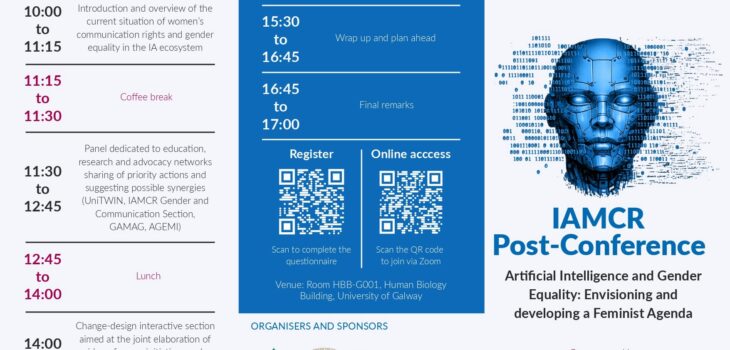
[1] This statement is an outcome of the International Association for Media and Communication Research (IAMCR) post conference titled “Artificial Intelligence and Gender Equality: Envisioning and developing a Feminist Agenda”. Galway, Ireland. July 3, 2026